Real life has
a play button.
Bingmong is the home of real-world play — the AI engine, the money rail and the graph of record for the billions of social games people play offline.
We gather less — and when we do,
the room goes quiet.
Play is how humans bond in person. But the gathering is breaking: kids sit side-by-side on Roblox; adults at dinner scroll TikTok because they're bored. The hardest part of a great game night isn't wanting one — it's making one happen.
Why it's hard: schedules never align · coordinating people, structure and money is work · a genuinely good game is hard to design — so everyone defaults to the same five.
Every platform captured digital play.
Nobody captured the room.
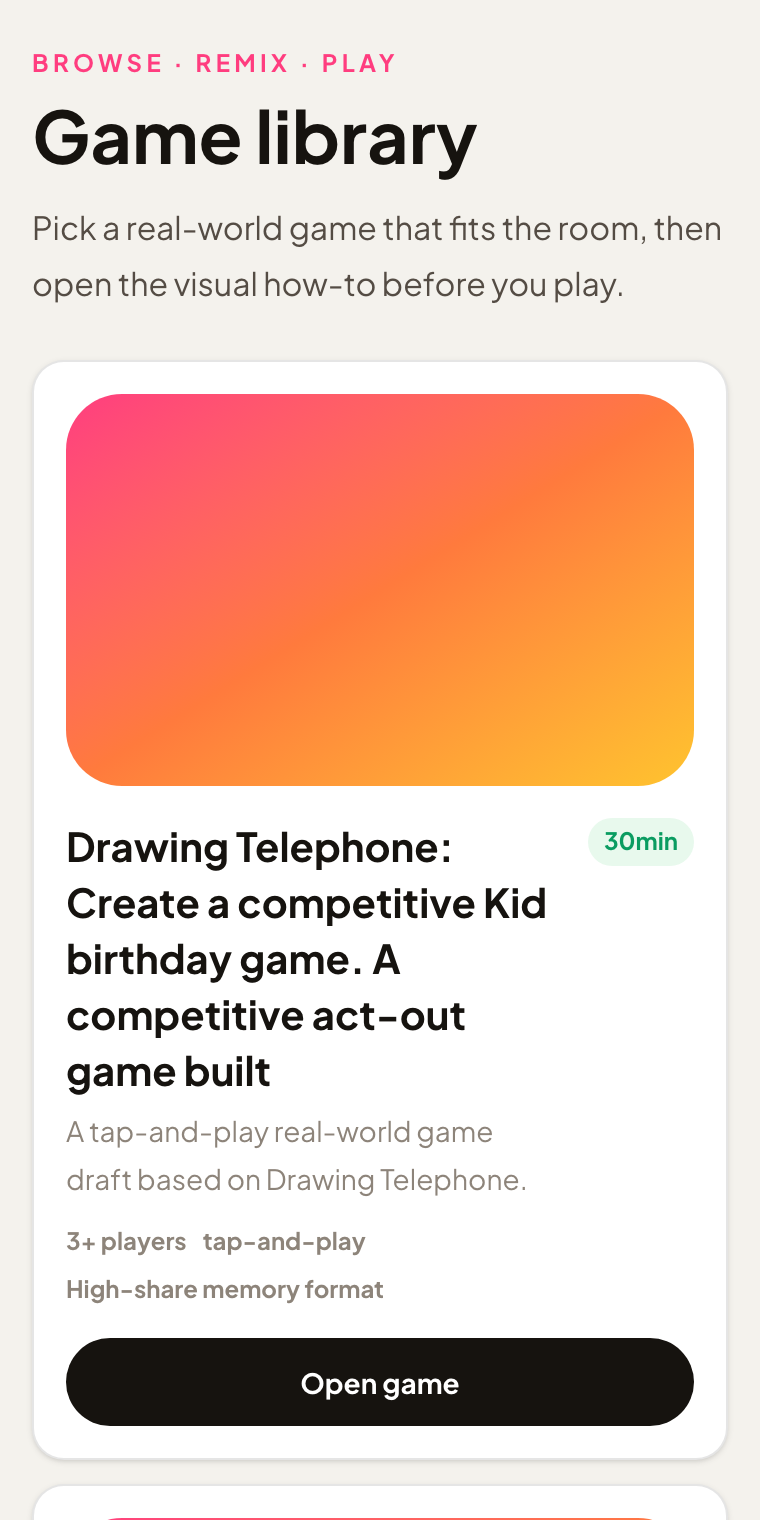
No real-life game — charades, cards, drawing, guess-who, the games your family invented — has ever been captured, structured, templated, remixed, replayed and kept as a memory. It was impossible before AI.
AI is the unlock
A good game is hard to design — creativity plus dozens of variables. AI turns one rule-set into infinite, difficulty-rated, context-aware variation, editable up to the last minute. Everyone becomes a god-tier game designer.
The grandma test
AI tailors the same game so a non-English-speaking grandma can finally play with the grandkids. That's the undeniable proof this is an AI unlock, not a rulebook — and a moat a static catalogue can never cross.
AI designs the game. People play it for real.
The play becomes content — automatically.
Bingmong is one loop: Create → Play → Capture → Remix → Share. The capture is a byproduct of playing — so the feed has no cold-start risk, and every play feeds back into the engine.


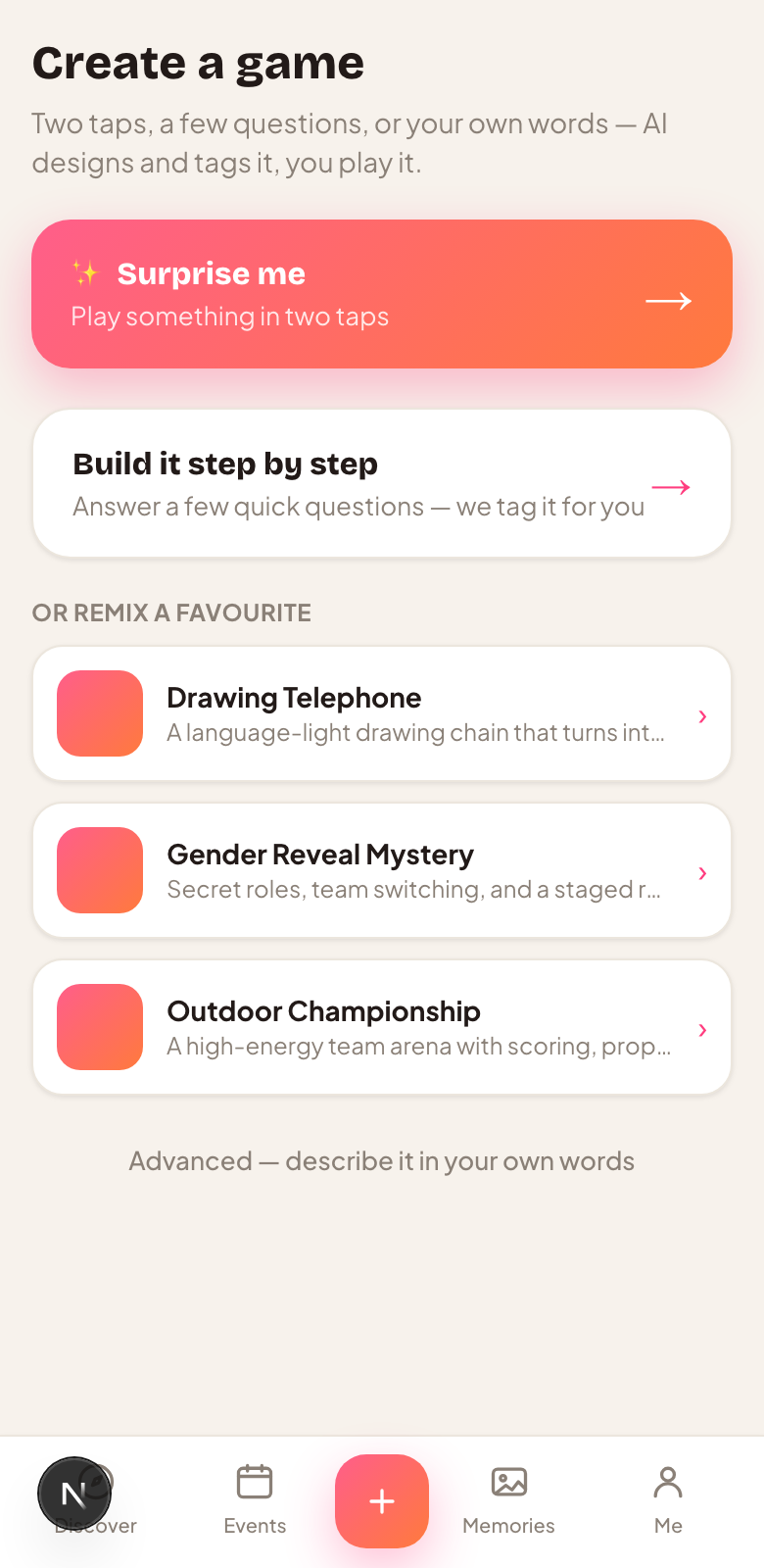
A few taps → a structured, tagged, difficulty-rated game.
Real incentives pull people to play in the room, not on a screen.
Memory · feed · discovery · brand-proof — one byproduct, four jobs.
House-rules → global format. Play becomes a reusable, ownable asset.
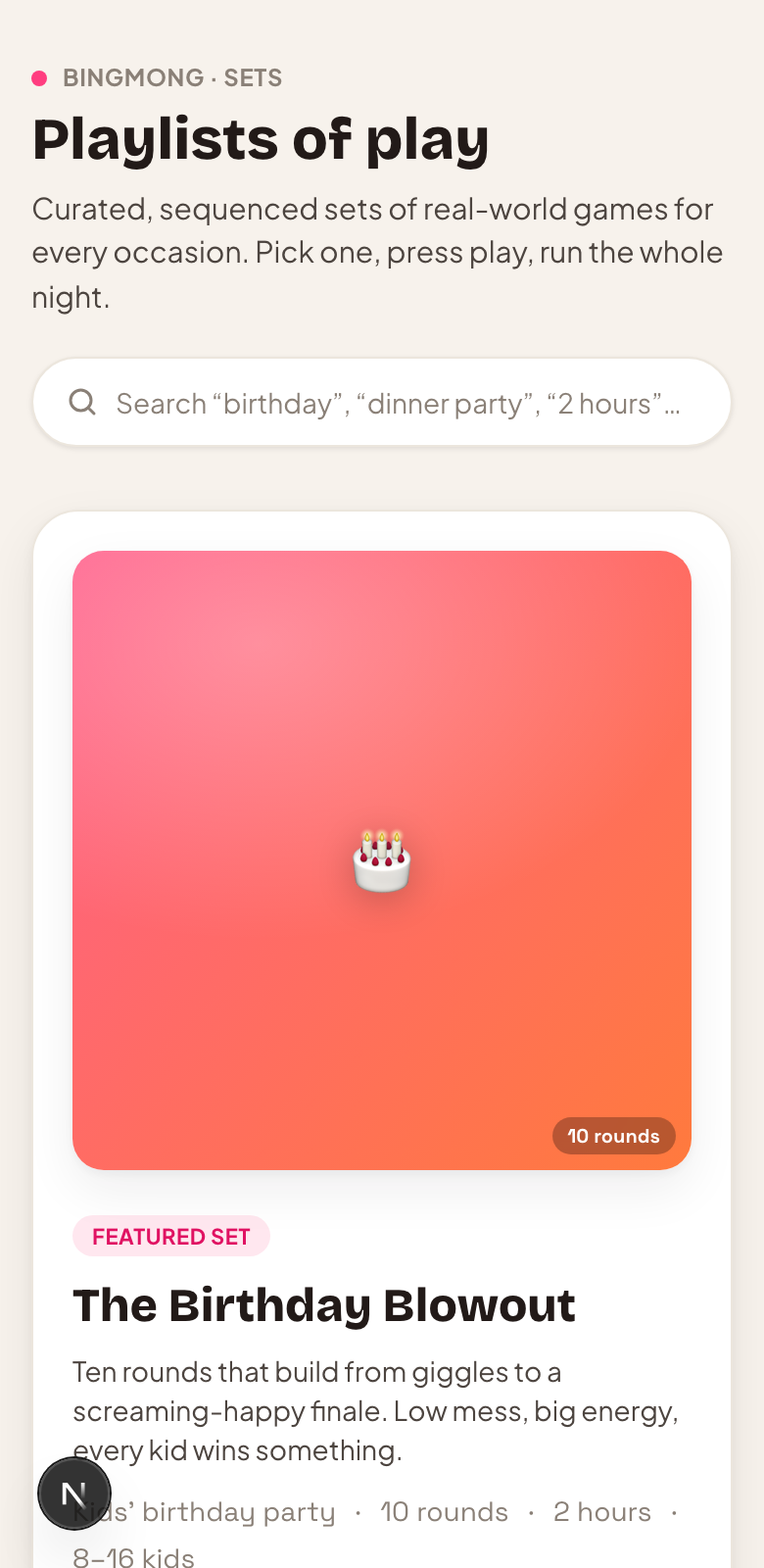
The Set — a playlist of play.
Single games are tracks; the Set is the album — a curated, sequenced run-of-show for an occasion: a birthday, a team offsite, a first date, a street festival. It's the unit hosts share, creators sell, and brands sponsor.
Like film, play has a spectrum
Clip → quick game → full session → league. A 90-second dare and a season-long house tournament live on one ladder.
Made to remix
Start from a creator's Set, swap a round, restyle it for your crowd. Every fork is a new node in the graph.
Aggregation, not cold start
We gather the games people already love — the Netflix / Spotify / Roblox playbook — then let anyone create, play and monetise.
Monetise the money around the gathering —
never the game.
Real gatherings already move real money: gifts, food, props, prizes, payouts. Today it's messy group-chats and IOUs. Bingmong makes it one prefunded, accountable rail — and takes a margin on the flow.
Three-rail economy keeps it compliant: cash = optional gift · tokens = earned play-money (never cashed out) · Karma = earned trust. No rail buys an edge on another — not pay-to-win, not gambling. Powered by Airwallex. Counsel-gated; built compliant.
The moat is the graph of real plays —
AllTrails for play.
The AI generator is a commodity. The defensible asset is the proprietary record of which games actually work — for whom, where, and with what outcome. Every play, remix and memory compounds it. No one else is collecting this.
Compounding data
Each captured game makes the next recommendation, generation and match better. A flywheel competitors can't backfill.
Two-sided liquidity
Hosts bring crowds; creators bring formats; brands/venues bring rewards. Local density is hard to copy city-by-city.
The money rail
Once the cash for an event flows through us, switching cost is real. The graph + the rail reinforce each other.
A big, real wallet — the money
already spent on gathering.
We don't need a new behaviour or a new budget. We intermediate spend that already happens around social gatherings and experiences.
TAM anchors on a single published market (events); adjacent markets show expansion, not an additive stack. SAM is a Bingmong estimate; SOM is a Year-5 target, not a forecast.
Everyone owns one corner.
We own the intersection.
Event tools move logistics but have no play layer. Game apps make play but it's on a screen and ephemeral. AI generators spit out a game and forget it — no graph, no money, no memory.
Bingmong is the only one in the top-right: AI-designed, real-world, persistent, remixable, and monetised.
Where each one stops.
| Player | AI game design | Real-world play | Persistent remix graph | Money rail | Status |
|---|---|---|---|---|---|
| Playbyte feed of games | Some | No · screen | No | No | Shut down · ~$4M raised |
| Rec Room UGC metaverse | No | No · VR/screen | In-app only | No | $3.5B peak · closing Jun 2026 |
| AI party generators CrowdParty · GameNight · Little Umbrella | Yes | At a screen | No | No | Generator only · commoditised |
| Goosechase scavenger / IRL games | No | Yes | No | No | Niche · no economy |
| Eventbrite · Luma · Partiful event hosting | No | Yes · logistics | No | Tickets only | No play / game layer |
| Bingmong | Yes — native | Yes — the point | Yes — the moat | Yes — built-in | The intersection |
The closest pure "feed of games" (Playbyte) died building it cold. We don't — the feed turns on as real plays accrue. Competitor facts from public reporting; see appendix.
One tool, a rising money motive —
climbed one city at a time.
Same product, four host rungs. Each rung adds a bigger reason to bring money through the rail. We win local density before we widen.
Bingmong 001: Leon's birthday is our first design partner — the live proving ground for the parent rung. The public feed is the front door (acquisition funnel), measured on views → game-save → host-intent → booked — never DAU vs. TikTok.
A marketplace, scored like a marketplace.
We make money on the flow, not the clicks. The right scorecard is liquidity × transaction value × supply retention — Airbnb / Eventbrite economics, not an ad feed.
Revenue lines
- Take-rate on money through the rail (pooled funds, payouts, rewards)
- Creator marketplace — sponsored & premium Sets
- Brand & venue placements inside real play
- Subscriptions for power hosts & clubs
What we measure
- Local liquidity (events that fill, per city)
- GMV through the rail × take-rate
- Host & creator retention
- Funnel conversion → booked events
Built and live — pointed at the first city.
This is a working product, not a concept deck. The platform is deployed; the first real event is the proving ground.
Honest status: pre-revenue, pre-launch on paid GMV. Next 6 months — run the first real events, turn on the rail, and prove host → booked conversion in one city.
Fund the first city. Own the
graph of real-world play.
We're raising to run the first cohort of real events, switch on the Airwallex money rail, and prove the host money-ladder in one city — the template we then repeat.
Airwallex AI Founders
The financial infrastructure for real-world play — prefunded treasuries, gig payouts, brand/venue settlement, cross-border. Our $100k program pitch.
Use of funds
First-city event ops · money-rail go-live · creator & host supply · the graph that compounds from day one.
The long game
Bingmong Houses — owned & franchised play venues per city, tap-band tracked, AI-rotating content. The graph, made physical.